How to Sleep Better at Night: The Four Changes That Actually Work
TL;DR: Sleeping better at night is mostly a timing and light problem, not a willpower problem. Four changes do most of the work: fix your wake time before your bedtime, get bright light within an hour of waking, dim the room two hours before bed, and stop consuming caffeine eight hours before sleep. Everything else — supplements, apps, elaborate routines — is refinement on top of those four.
Start with the wake time, not the bedtime
Most people try to fix sleep by going to bed earlier, and most people fail at it. The reason is that sleep onset is largely controlled by your circadian rhythm, and the strongest lever on that rhythm is when you get up and when you see light.
Fix the wake time first. Pick a time you can hold seven days a week, set it, and get out of bed when it arrives even after a bad night. Within one to two weeks, sleep pressure accumulates at the right hour and falling asleep becomes easier without effort.
The exception people resist is weekends. A two-hour lie-in on Saturday and Sunday shifts your rhythm later by roughly the same amount, which is why Sunday night is the worst night of the week for many people. Holding within an hour of your weekday time is the single most effective change available.
Get light early, lose it late
Light is the signal that sets the clock. Bright outdoor light in the morning advances the rhythm; bright light in the evening delays it.
The practical version: get outside, even briefly, within an hour of waking. Outdoor light on an overcast day is far brighter than indoor lighting, so ten minutes outside beats an hour in a lit kitchen. If you cannot go out, sit facing a window rather than away from it.
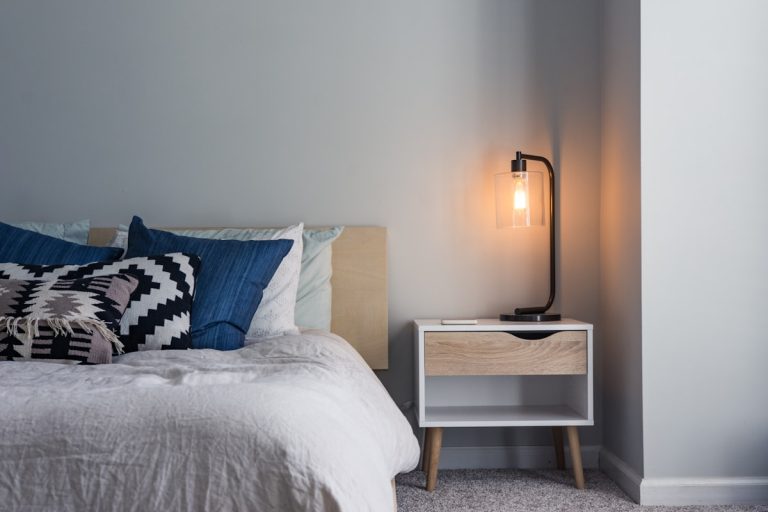
In the evening the goal is dimness, not darkness. Switch off the overhead light and use lamps below eye level. Screens matter less than their brightness relative to the room — a phone at low brightness in a dim room is a smaller signal than a phone at full brightness in a dark one.
Caffeine has a longer tail than most people assume
Caffeine has a half-life of about five to six hours in most adults. A coffee at 3 p.m. leaves roughly a quarter of its dose in your system by midnight, which is enough to fragment deep sleep even when you feel like you fall asleep fine.
That last point is what makes caffeine hard to self-diagnose. It rarely stops you falling asleep; it reduces the depth and continuity of sleep you get, which shows up as feeling unrefreshed rather than as insomnia.
The workable rule is a cutoff eight hours before bed. If that feels unrealistic, the honest next step is to move the cutoff earlier by an hour at a time rather than to cut caffeine entirely.
Alcohol and late meals
Alcohol is the most misleading sleep aid available. It shortens the time to sleep onset, which feels like it helps, then fragments the second half of the night and suppresses REM. A night with several drinks typically produces a long unbroken first half and a restless, early-waking second half.
Large meals close to bedtime cause the same class of problem from a different direction: digestion raises core temperature and creates reflux, both of which disturb the later part of the night. A two-to-three hour gap between dinner and bed is the usual recommendation, and it matters more for anyone prone to heartburn.
Temperature, and why the room matters
Core body temperature falls as sleep begins, and the drop is part of the signal, not a side effect. A room that is too warm fights that process.
Most people sleep best in a room around 16 to 19 degrees Celsius, which is cooler than most living rooms. The practical fixes are cheap: a lighter duvet rather than a warmer room, and a warm shower ninety minutes before bed, which cools the skin surface as you dry off and accelerates the core temperature drop.
The 20-minute rule
If you are awake and frustrated in bed, the instinct is to stay put and try harder. That instinct reliably makes things worse, because it teaches your brain that the bed is a place of alertness.
The standard advice is to get up after roughly twenty minutes and do something quiet in dim light until sleepy, then return. It feels counterproductive the first few times and it is the most consistently effective behavioural change for chronic difficulty falling asleep.
What to measure, and what to ignore
Sleep trackers are useful for spotting trends and unreliable for judging any single night. Their estimates of deep and REM sleep are inferred from movement and heart rate rather than measured, and they are wrong often enough that acting on one night’s number is counterproductive.
What is worth tracking is simple and self-reported: the time you got into bed, the time you got up, and how you felt at midday. Three numbers, recorded for two weeks, reveal more than a month of device data.
If you want to work out the timing that fits your own sleep cycles rather than an average, a sleep cycle calculator is a reasonable starting point — but treat its output as a hypothesis to test for a week, not a prescription.
The short version
Fix the wake time, get morning light, dim the evening, cut caffeine eight hours out, keep the room cool, and leave the bed if you are awake and frustrated. Those six changes are the whole of the evidence-backed core. Everything else is a smaller effect, and most of it is optional.